Pustular Psoriasis
Pustular psoriasis presents as fluid-filled pustules which form on top of red or darkened skin.
About pustular psoriasis
When people use the term ‘pustular psoriasis’, it can refer to pustular psoriasis of the palms and soles, also referred to as Palmoplantar Pustulosis (PPP), and Generalised Pustular Psoriasis (GPP) which refers to pustular psoriasis across the body.
The pustules that are seen in both types of pustular psoriasis are sterile and are not contagious or infectious.
Palmoplantar Pustulosis (PPP)
What are the main signs and symptoms of PPP?
(‘palmo’ meaning palm of the hand and ‘plantar’ meaning sole of the foot) is a rare condition which causes pustules filled with fluid on the palms of the hands and the soles of the feet.
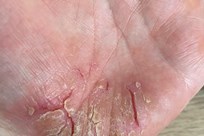
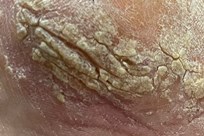
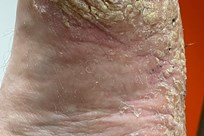
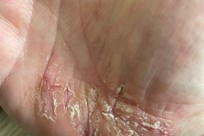
The pustules are small, round and yellow and can look similar to blisters containing pus. They appear under the skin surface of the palms or soles and can affect just the hands, just the feet, or both. They can also be very itchy and painful.
They gradually turn brown as they reach the surface and are shed as scales. They are not infected or contagious but are simply a collection of cells. As it can often look very similar to a fungal infection, a doctor may take a skin scrape to check for this or to rule out a bacterial infection. Psoriasis on the hands and feet that is not pustular is usually plaque psoriasis.
As with other types of psoriasis, PPP can be anything from mild to severe, and can wax and wane.
What causes PPP?
The cause of PPP is not completely understood. There is a strong association between palmoplantar pustulosis and cigarette smoking, which is one of the most common risk factors for developing the condition. Up to 95% of people with Palmoplantar pustulosis either currently smoke or have smoked in the past. Other possible triggers include metal sensitivities (particularly to nickel), infections, trauma, stress, and certain medications.
Anybody can get palmoplantar pustulosis, but it is more common in women than in men. It is rare in children. Those with family members who have palmoplantar pustulosis or psoriasis are more likely to be affected and it is more common in people who have other autoimmune conditions such as arthritis, diabetes, thyroid disorders, or coeliac disease.
How can PPP be treated?
Topical Treatment
Treatment is likely to begin with topical (applied to the skin) treatments, including steroid creams and coal tar applications. A healthcare professional may advise steroid-based treatments to be applied under occlusion (applied and then wrapped under clingfilm, for instance), as it can help the treatment it to be absorbed through thickened skin. This must only be done on advice from a healthcare professional, and is not appropriate for all types of psoriasis or all body areas.
Other topical treatments such as coal tar or salicylic acid may also be used, to help reduce thick scaling.
As with all types of psoriasis, it is important to moisturise well and regularly, as this will help the skin to feel more comfortable, and can help ‘active’ topical treatments (such as steroid creams) to be better absorbed. In the case of PPP, moisturising can also help to prevent or reduce cracking of the skin.
PUVA
PPP can be stubborn to treat, and, should this be the case, a Dermatologist may prescribe a course of Psoralen Ultraviolet A (PUVA) therapy. PUVA therapy for the hands and feet involves taking oral psoralen or applying topical psoralen to the affected areas before exposure to the ultra-violet A radiation. This is especially useful for the feet as the patient sits with the soles exposed to a small UVA machine, as opposed to standing in a cabinet, where the soles are not reached by light.
Systemic and Biologic Treatments
Other medications that can be used to treat PPP include the oral retinoid acitretin, and oral systemics methotrexate and ciclosporin. Whilst biologic injection treatments are available for the treatment of severe psoriasis, certain types have been found to trigger or worsen PPP, and so these should be avoided.
Generalised Pustular Psoriasis (GPP)
What is generalised pustular psoriasis?
GPP, which can also be known as von Zumbusch psoriasis, is quite rare, but is a serious, life-threatening condition that requires urgent medical attention. It is widespread across the body, with sheets of very small sterile fluid filled pustules on very red, hot and inflamed skin.
It is considered a medical emergency, and a person can become very ill as the skin’s ability to regulate temperature is affected.
What are the main signs and symptoms of GPP?
As with PPP, the main symptom of GPP is small pustules on a background of very red or dark skin, on any area of the body. These pustules are filled with fluid which often gives them a yellow or cream colour, and they often merge into one another to create large areas of pus. These areas eventually dry and peel, before new crops of pustules appear. The skin often feels hot to the touch, and may be sore, tender or itchy.
Someone with GPP may feel feverish and have flu-like symptoms. Headaches, nausea, fatigue, shivers and a high temperature can also be experienced. These flares can usually last between 2-5 weeks but can persist up to 3 months.
GPP can sometimes develop if very large amounts of strong steroid creams have been used to treat widespread plaques for a long time. It can also be triggered by using certain medications or by pregnancy.
What causes GPP?
The precise cause of GPP is unknown. Although it has historically been grouped with plaque psoriasis, GPP is a distinct condition. It involves different processes in the immune system and often requires different treatments. Some people who develop GPP have, or have previously had, another form of psoriasis, but this is not always the case.
There are a number of potential triggers for GPP, although these are not true to every person, and many people do not identify the trigger for their condition. It is more common in females and unlike plaque psoriasis, it is more prevalent in people of Asian ethnicity.
Possible triggers include:
- Suddenly stopping any kind of steroid medication (steroids should always be weaned off)
- Medications, including certain anti-depressants, certain sedatives or anti-epileptics, certain beta blockers, certain non-steroidal anti-inflammatories, hydroxychloroquine, salicylates, and topical treatments that cause irritation or that are put under occlusion (covered)
- Infections or other illnesses
- Pregnancy
How can GPP be treated?
GPP is a serious condition, so it is essential that medical advice and treatment is sought immediately. People with GPP often need to stay in hospital to get more fluids into the body, stabilise temperature, and try to carefully bring the skin under control.
Treatment for GPP is usually cautious, to hopefully avoid aggravating the skin any further. Initially, affected areas will be treated with bland non-‘active’ treatment, for example emollient, compresses and/or oatmeal baths, to soothe the skin. Treatment may then move onto acitretin - an oral retinoid - or other systemic or biologic medications. PUVA may be used if appropriate. Antibiotics may also be prescribed, if an infection is present.
February 2017 (Review Date: February 2020)