Guttate Psoriasis

Guttate psoriasis is a distinctive form of psoriasis that occurs most often in children, teenagers and young adults.

About guttate psoriasis

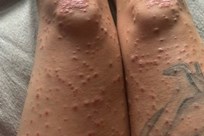
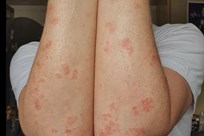
Guttate psoriasis is also known as ‘tear drop’ or ‘rain drop’ psoriasis. It can occur at any age, but is seen most often in children, adolescents and younger adults. It is characterised by a generalised rash of small spots that, that can be up to one centimetre in diameter, and is widespread across the body.

Usually, guttate psoriasis is widespread across the torso, back and limbs, and clears up after several weeks or months, depending on how quickly treatment is started. It can occur in people who have never had psoriasis before, appearing suddenly following a streptococcal infection, usually of the throat or tonsils, or it can develop in someone who already has long-term plaque psoriasis. It does not often affect the palms and soles and usually clears up after several months depending on how quickly treatment is started.

Some people will not have a further flare, but others may continue to have sporadic flares, or find it evolves into one of the other types of psoriasis.

What are the main symptoms of guttate psoriasis?

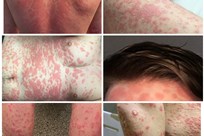
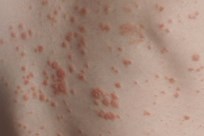
Guttate psoriasis causes a rash of small spots (up to 1 centimetre in diameter), which are widespread across the torso, back, limbs, and sometimes neck, head and scalp. These spots are often a bright pink or red on fair skin types, whilst people with darker skin types may notice the psoriasis patches are dark rather than red. There may also be some fine scaling on guttate spots. Some people report guttate psoriasis as being very itchy or sore, whilst others do not notice this.

What causes guttate psoriasis?

Guttate psoriasis seems to occur most often in children, teenagers and young adults, although it can occur in older adults. Guttate psoriasis is often triggered after a streptococcal throat infection, and so people who are prone to this type of infection may experience repeat bouts of guttate psoriasis. In some cases, other viral or bacterial infections may trigger guttate psoriasis.

How can guttate psoriasis be treated?

Psoriasis is a condition that is unique to each person who has it, and so finding a treatment or combination of treatments that work can be a process of trial and error. Click on the headings below to learn about treatments for guttate psoriasis.
Topical Treatment

Guttate psoriasis treatment is likely to begin with topical (applied to the skin) treatments, including steroid creams, vitamin D applications, and coal tar applications. It is important to check with a doctor, nurse or pharmacist how to use these treatments, and to follow the directions on the patient information leaflet.

The National Institute for Health and Care Excellence (NICE)’s Clinical Guideline for the Assessment and Management of Psoriasis (2012) recommends that an appointment to review treatment is made four weeks after starting a new treatment, for adults, and after two weeks for children.

As with all types of psoriasis, it is important to moisturise well and regularly, as this will help the skin to feel more comfortable, and can help ‘active’ topical treatments (such as steroid creams) to be better absorbed.

Ultraviolet Light Therapy

Guttate psoriasis often clears up on its own after a number of weeks, or a few months. If it carries on, and topical treatments do not seem to help, a referral to a Dermatologist may be needed. A Dermatologist may offer Ultraviolet (UV) Light Therapy to treat persistent guttate psoriasis. This kind of treatment is used to treat various skin conditions, and is often quite effective in guttate psoriasis.

UV therapy is normally given 2 or 3 times a week for 6 to 8 weeks at a time – this usually takes place in the dermatology department at a hospital, or in larger health centres. The levels and dose of UV prescribed by a dermatologist is carefully calculated and is much more precise and a different wavelength to the UV light emitted from a sunbed.

Antibiotics and Tonsillectomy

There is some debate around whether antibiotics (to treat the streptococcal infection that often triggers guttate psoriasis) are useful in the treatment of guttate psoriasis. Some people arrange with their doctors to prescribe them antibiotics as soon as they notice a sore throat, as there is a school of thought that bringing the streptococcal infection under control can also control the psoriasis flare. However, there is no good scientific evidence to prove that this approach works, and the NHS now has a stricter approach to prescribing antibiotics than in the past.

Tonsillectomy (removal of tonsils) is also sometimes discussed as a possible treatment for guttate psoriasis. Tonsillitis is a common streptococcal infection, which can trigger guttate psoriasis. Again, there is debate about whether removing the tonsils is an appropriate treatment for guttate psoriasis, as the scientific evidence that is available is mixed.

Resources

The information on this page is also available in our guttate psoriasis information sheet.

February 2017 (Review Date: February 2020)

The information on this page is currently under review.