11 November 2026
Research results revealed: JAKPPPOT trial
A new palmoplantar pustulosis (PPP) study has recently had its findings published.
'JAKPPPOT' looked at the potential use of 'upadacitinib’ in patients with PPP. Dr David Gleeson led the research team at St John’s Institute of Dermatology and Guy’s and St Thomas’ NHS Foundation Trust. The study was supported by Psoriasis UK, who helped to recruit people with PPP to take part.
What is PPP?
PPP takes its name from ‘palmo’ (meaning palm of the hand) and ‘plantar’ (meaning sole of the foot). It is a rare condition which causes pustules filled with fluid on the palms of the hands and the soles of the feet.
The pustules are small, round and yellow and can look similar to blisters containing pus. They appear under the skin surface of the palms or soles and can affect just the hands, just the feet, or both. They can also be very itchy and painful.
What did the study find?
The improvements for patients receiving treatment were encouraging:
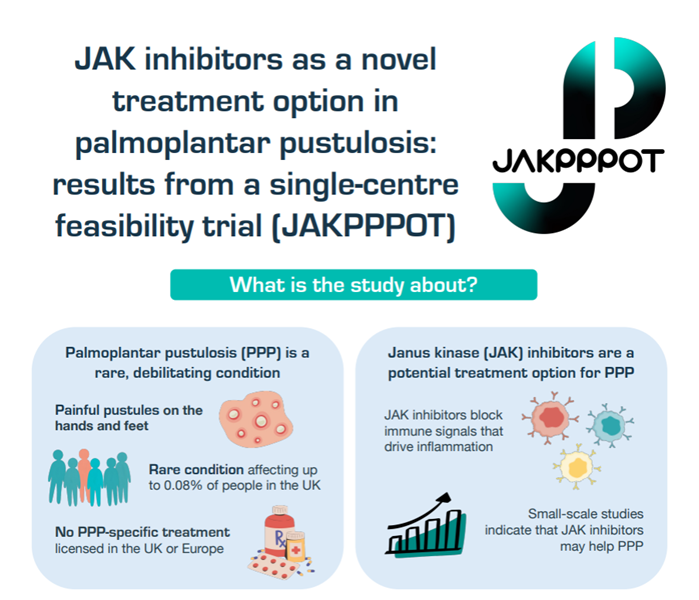 Click to enlarge
- 100% of people receiving treatment achieved at least a 50% improvement
- 65% achieved at least a 75% improvement
The study demonstrated that a larger trial of upadacitinib to treat PPP would be possible. Although a larger trial is still needed, these results represent an important step.
What happens next?
The trial was also selected for presentation at two major European dermatology conferences.
Unfortunately, the funding position for upadacitinib remains unchanged. This means it cannot be offered as treatment for PPP.
However, the JAKPPPOT team are working to secure further research and make this treatment more widely available.
There is also encouraging news for PPP research more generally. Two commercial clinical trials are now underway investigating new treatments for PPP. One trial involves a cream, and another an injectable treatment.
Where can I find out more?
To learn more, you can:
- Download the summary infographic
- Read the full publication in the British Journal of Dermatology
- Read an interview given by Dr Gleeson about the JAKPPPOT study