21 September 2026
HPOS study - your questions answered
Places are still available on this exciting global study. Here’s some of our frequently asked questions about taking part…
The project, led by the University of Oxford in collaboration with University College Dublin, aims to understand how psoriatic arthritis (PsA) develops in people with psoriasis, and eventually, to prevent its development completely.
Is there any criteria to take part?
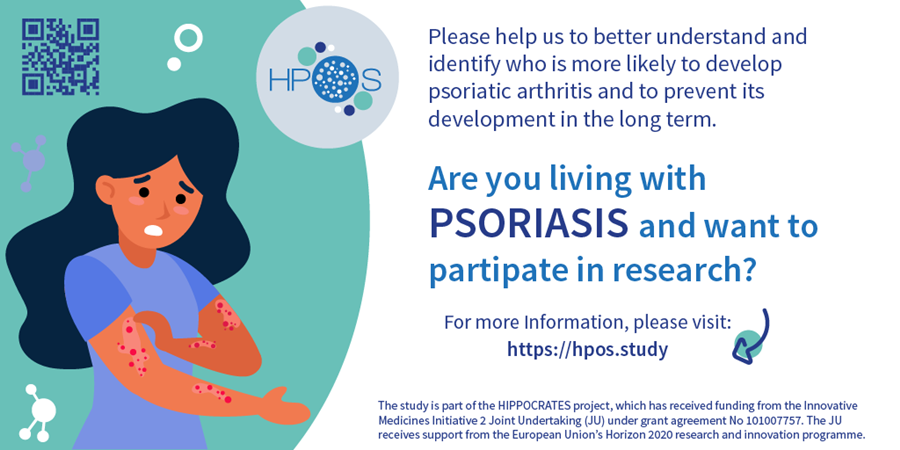
The study is interested in any adult with psoriasis. If you are an adult living with psoriasis in Europe, and you do not already have a diagnosis of psoriatic arthritis, you are eligible to take part.
 Click to enlarge
How long does the study take?
Participants will be monitored over a three-year period to see who develops PsA.
Do I have to travel?
No -the study will take place 100% online. Participants will fill in questionnaires online and send small finger prick blood samples by prepaid post.
How is the UK study linked to the wider European study?
HPOS is part of wider research called The HIPPOCRATES project. Over 25 research groups across Europe, led by Professor Oliver FitzGerald in Dublin, aim to answer four key research questions around:
- Psoriasis diagnosis
- PsA prediction
- PsA response to therapies
- Prognosis on who will get joint damage.
Why is this study being done?
Professor Laura Coates, NIHR Clinician Scientist and Senior Clinical Research Fellow at NDORMS, University of Oxford, said:
"At the moment there is no way to predict which patients with psoriasis are likely to go on to develop joint problems. We think this group of patients will help us to completely change how we think about the development of PsA and how to predict it."
What are the long-term goals of the study?
Professor Laura Coates is hopeful that the study will help to design prevention studies. This could be drug treatments or lifestyle interventions such as exercise or stress management. The overall long-term aim is to prevent people with psoriasis developing arthritis.
How can I find out more?
For more information, or to express an interest in taking part, you can visit the HPOS study website.